What I Read This Week: a summary of the content that I consumed this week…
Caught My Eye…
1) Gemini 3 Deep Think: A New Era of Reasoning
On February 12, 2026, Google DeepMind announced a big upgrade to Gemini 3 Deep Think, a specialized reasoning mode designed to solve the world’s most complex scientific, research, and engineering challenges.
This model enables researchers to interpret complex data and engineers to model physical systems through code. In a featured example, the Wang Lab at Duke University optimized fabrication methods for complex crystal growth to discover new semiconductor materials. Deep Think successfully designed a recipe for growing thin films larger than 100 μm.
The performance metrics released with this launch are record-breaking across every major technical domain. Gemini 3 Deep Think set a new high-water mark of 84.6% on ARC-AGI-2, a benchmark designed to test a model’s ability to adapt to entirely new tasks. This is almost double their previous score of 45.1% 3 months ago. Currently, only seven humans have a higher elo than Deep Think’s score of 3455 on Codeforces.

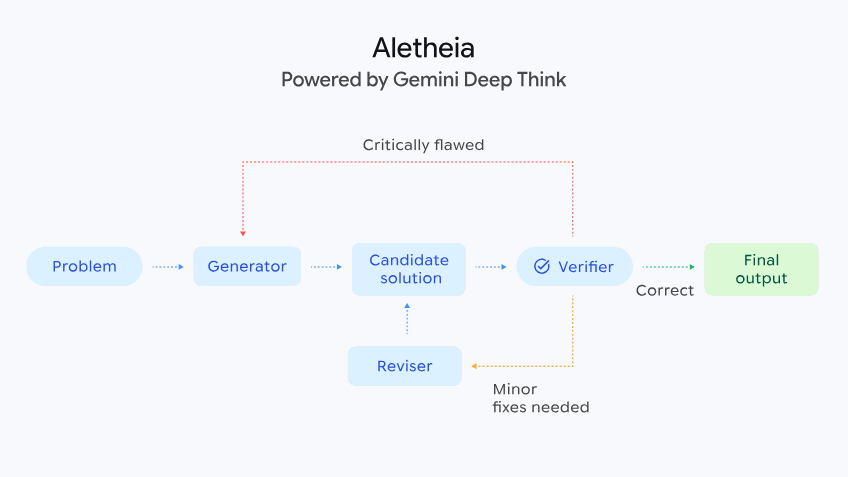
Additionally, Deep Think can now interpret messy experimental data, assist in autonomous scientific research, and turn a hand-drawn sketch into a functional 3D-printable CAD file. This shows that scaling laws continue through inference-time computation. One application that showcases this is their math research agent, Aletheia, which autonomously follows a specific process to get the highest-quality answer.
2) Agentic Wallets: Giving AI Agents Purchasing Power
On February 10, 2026, Coinbase announced the official launch of Agentic Wallets, a first-of-its-kind infrastructure designed specifically for autonomous AI agents. While previous AI models could advise or summarize data, they often hit a wall when a task required a financial transaction. These new wallets remove the human bottleneck, enabling AI agents to independently hold funds, execute trades, and pay for resources such as API keys and compute power without needing manual approval at each step.
“Now agents can spend, earn, and trade autonomously and securely.” – Brian Armstrong, CEO of Coinbase
The technology is built on the x402 protocol, an open protocol for internet-native machine-to-machine transactions, that has already processed over 50 million transfers. To ensure safety, Coinbase has integrated Smart Security Guardrails that allow developers to set session spending caps and transaction limits.
This launch signals the arrival of the Agentic Web, where autonomous bots can manage DeFi portfolios, rebalance liquidity at 3 AM, or monetize their own generations in the creator economy. Coinbase is lowering the barrier for developers by offering gasless trading on its Base network and believes we are now in the age of AI agents that can act, not just advise.
3) Isomorphic Labs Unveils The Successor to AlphaFold
On February 10, 2026, Alphabet’s biotech subsidiary Isomorphic Labs announced the launch of the Isomorphic Labs Drug Design Engine (IsoDDE). Its predecessor, AlphaFold 3, won a Nobel Prize for predicting static 3D structures of molecules. IsoDDE shifts focus from observation to engineering. This new platform is “full-cycle,” designed to predict how new drugs bind to their targets and whether they have a therapeutic effect.
IsoDDE more than doubles AlphaFold 3’s accuracy on out-of-distribution benchmarks.
This means it can predict the structure of new protein-ligand systems that the model didn’t see during training. The engine can find cryptic pockets using just an amino acid sequence. Most proteins are dynamic, which means they have binding sites that appear briefly as they move. Earlier AI models only detected a smooth surface, leading researchers to label many aggressive cancers and neurodegenerative diseases as undruggable. The IsoDDE uses advanced reasoning to mimic this molecular motion and uncover these cryptic areas. This allows scientists to design precise drugs targeting KRAS, a cancer-driving protein, and to use Cereblon, a substrate receptor.
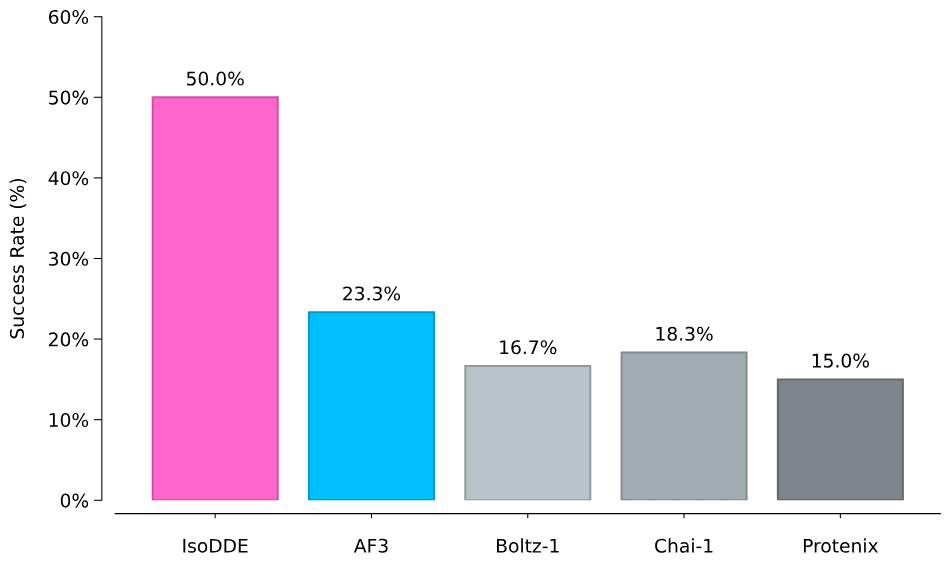
In August 2025, Deep Origin, another biotech firm, presented results at the Aging Research and Drug Discovery (ARDD) conference. Their physics-informed docking engine, DODock, outperformed AlphaFold 3 on the same benchmark as IsoDDE.
“We’re glad to see Isomorphic Labs reaching performance levels comparable to what we presented months ago. More accurate docking is good for drug discovery, full stop.” – Michael Antonov, CEO of Deep Origin (prev: Co-founder of Oculus and Scaleform)
Learn With My Friends and Me…
Other Reading…
-
Your AI Conversations Aren’t Privileged (Moish Peltz)
-
Sabotage Risk Report: Claude Opus 4.6 (Anthropic)
-
xAI Welcome to All Hands (xAI)
On X…