
Continuing the long tradition we started here at a16z, here are a few books the a16z crypto team is reading and recommending this summer.
This first part of our list is organized by curiosity: how does the world work, why do systems change, and what makes certain ideas, technologies, markets, and institutions take hold?
In this list, you’ll find books on manufacturing, biology, energy, market design, financial models, management, and more — books that trace how things work from first principles, unearthing the hidden structures behind progress and reinvention.
What powers life — and everything else
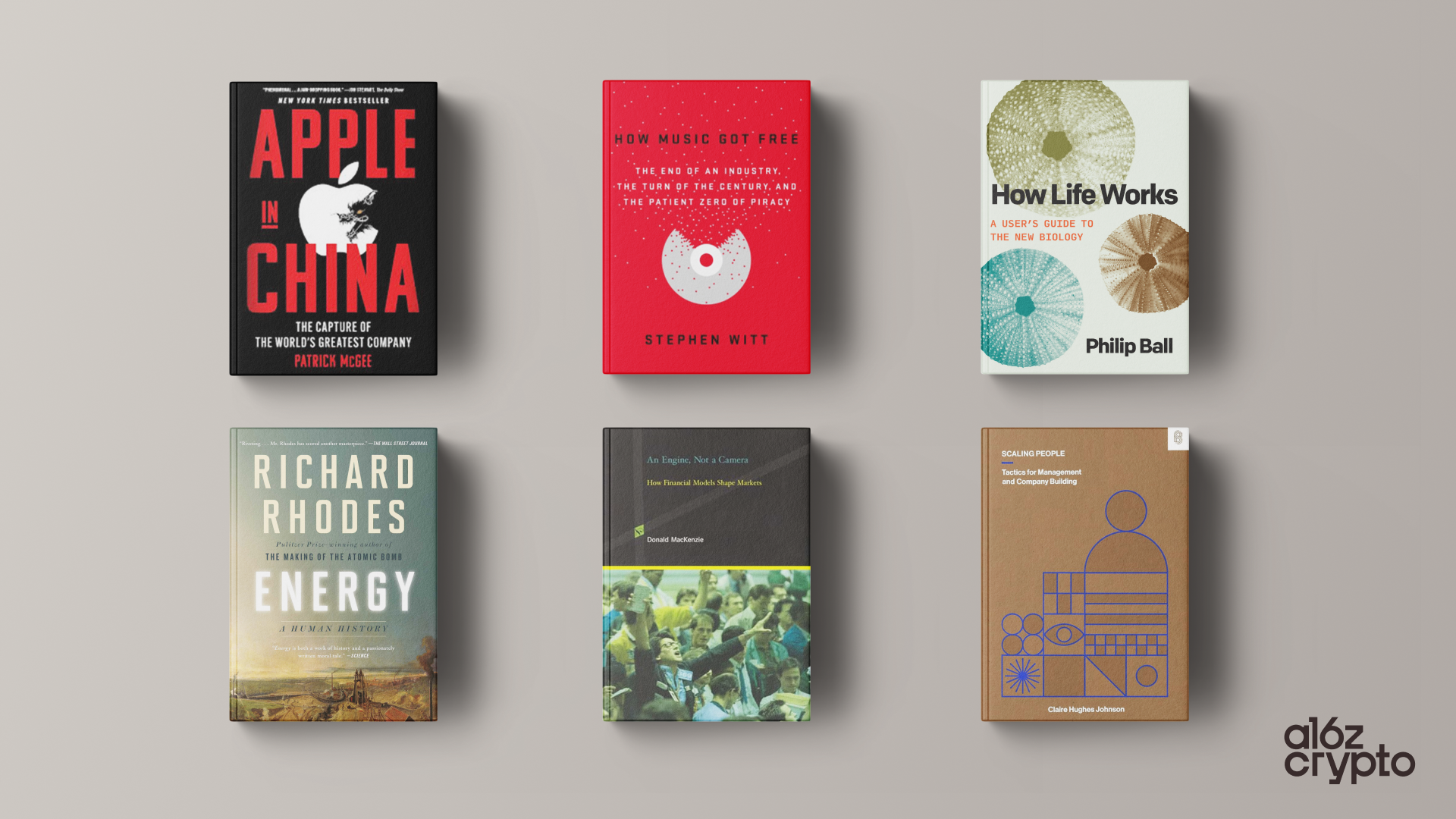
How Life Works by Philip Ball
“We all learn in basic biology that the cell’s DNA is a blueprint for life: genes are copied into mRNA, the mRNA is sent to the ribosomes, and the ribosomes make proteins that drive the cell. It is a simple story that is appealing to engineers. This book explains that the story of life is far more complicated and, in some sense, that the story we are taught is wrong. The book gives a more accurate, yet still incomplete, picture of how the billion molecules in a single cell interact to regulate the cell and keep it alive.” – Dan Boneh, research
The Art and Craft of Problem Solving by Paul Zeitz
“While I’ve been ‘Lean’-ing into formal mathematics this spring, I’ve also been revisiting classic works to fine-tune my mathematical thinking and problem-solving. And there’s no better book for that than Paul Zeitz’s magnum opus, now in its third edition.” – Scott Duke Kominers, research
Energy by Richard Rhodes
“Rhodes is the author of one of my favorite series of all time, the four-volume nuclear history that begins with the Pulitzer-winning The Making of the Atomic Bomb, plus several very good novels, if less heralded. Energy is his five-century study of how humanity moved from wood to coal to oil to electricity and on toward nuclear and renewables, told the way Rhodes tells everything: through people, and through false starts, bad bets, and inventors who accidentally solved the right problem.
Reading his work, it’s hard not to notice how often progress comes down to scaling capacity as much as fundamental breakthroughs — exactly the question the AI buildout is now forcing, as compute demand revives interest in nuclear and reshapes grids. The constraint on this next computing era may be joules rather than algorithms, a challenge we’ve navigated before.” – Aiden Slavin, policy
How technology becomes an industry
Apple in China by Patrick McGee
“How did China become so good at tech manufacturing? This book tells the story of how Apple spent over a decade and significant resources training firms in China to build Apple products to stringent requirements and with high precision. Along the way, it tells the history of many Apple products and how they came to be. It is an interesting story of how we ended up where we are.” – Dan Boneh, research
Apple: The First 50 Years by David Pogue
“An exhaustive march through 50 years of Apple’s history. Pogue has been chronicling Apple for so long (starting at Macworld in the 80s) that he’s one of maybe three people alive who’d get this kind of access, which is what makes it great. Dropped weeks before Tim Cook announced his exit, this text works as a bookend, catching Apple right as one chapter closes and another cracks open.“ – Drew Coffman, editorial
How Music Got Free by Stephen Witt
“Did you know that one CD manufacturing plant employee leaked thousands of albums before release, becoming an inadvertent kingpin of the warez scene? This book chronicles how technology repeatedly kneecapped the music industry over 20 years: MP3s begat piracy, which decimated CD sales; iTunes changed the album; YouTube opened up a new listening stream; VEVO made the music industry money again; and then streaming cannibalized everything. Reading this book makes it clearer that the music industry’s current model is just another temporary equilibrium waiting to be disrupted. A great example of how tech obliterates business models and forces reinvention.” – Drew Coffman, editorial
How markets are designed
Moral Economics: From Prostitution to Organ Sales, What Controversial Transactions Reveal About How Markets Work by Alvin E. Roth
“My doctoral advisor, Al Roth, has been thinking for decades about ‘repugnance’ – why some people prefer that some markets should not exist. In Moral Economics, he tackles the motivation for these prohibitions and the trade-offs they force, head-on. And he explores, in particular, how such non-market norms emerge and sometimes later collapse — limitations on alcohol and drugs, and, in a completely different category, same-sex marriage have all been relaxed in recent years — and what this means for making markets in the future.” – Scott Duke Kominers, research
Why Nations Fail by Daron Acemoglu and James A. Robinson
“Acemoglu and Robinson’s central thesis, that inclusive institutions drive prosperity while extractive ones cause stagnation, maps surprisingly well onto crypto. Decentralized protocols are essentially an attempt to hard-code inclusive institutions: open access, no gatekeepers, rules enforced by code rather than by whoever’s in power. The book is a great lens for understanding why certain blockchain ecosystems thrive while others are captured by insiders. A must-read for anyone thinking seriously about governance, whether at the nation-state or protocol level.” – Kira Song, finance
An Engine, Not a Camera: How Financial Models Shape Markets by Donald MacKenzie
“Sociologist Donald MacKenzie’s An Engine, Not a Camera is nominally a book about financial economics, but its real subject is more provocative: What happens when theories stop describing the world and start changing it? MacKenzie traces how academic models of markets escaped the university and became embedded in the markets themselves. First published in 2006, it remains relevant today in a number of contexts — not least because of the recent interest from TradFi in crypto. But I wanted to read it again because of the book I’m working on with colleague Robert Hackett, about how computer science theories acted on the world.” – Tim Sullivan, editorial
A Man for All Markets: From Las Vegas to Wall Street, How I Beat the Dealer and the Market by Edward O. Thorp
“Growing up, I was obsessed with the movie 21 and the idea that you could actually use math to beat the house. This book is the autobiography of the man who essentially started it all. Edward Thorp went on to apply those same principles to Wall Street, becoming the father of quantitative investing. It’s an incredible story about using pure logic to disrupt rigged legacy systems, which perfectly captures the same builder mindset we see in crypto today.” – Ben Wu, talent
How organizations are designed
The Super Gap (초격차, or Cho-gyeok-cha) by Oh-Hyun Kwon
“This book is written by the former chairman of Samsung Electronics, who led the company to become the world’s number one semiconductor company. ‘The Super Gap’ means a gap so wide that competitors cannot even think about challenging you. Based on his 33 years at Samsung Electronics, he distills his leadership experience into four pillars: leader, organization, strategy, and talent. The author explains that this ‘Super Gap’ applies not only to technology but also to systems, culture, people, and organization. It’s especially compelling because these insights come from someone who experienced both success and failure firsthand and ultimately walked away from the peak to practice the ‘sustainability’ he preaches.” – SungMo Park, go-to-market
Scaling People: Tactics for Management and Company Building by Claire Hughes Johnson
“My friend and co-author Jesse Shapiro recently recommended this book to me, and it’s fantastic: easily the best book I’ve ever read on both managing people and managing people’s interactions with you. Hughes Johnson, who served as COO at Stripe through their period of massive growth, gives a vivid and very, very practicable guide to understanding individuals’ and teams’ motivations and operating modes. The book comes with detailed principles and strategies for everything from hiring and onboarding to day-to-day management, communication, evaluation, and feedback. But the biggest payoff is the way the book trains awareness and recognition of people as they are, and how to build on that to help them maximize themselves.” – Scott Duke Kominers, research
You’re receiving this newsletter because you signed up for it on our websites, at an event, or elsewhere (you can opt out anytime using the ‘unsubscribe’ link below). This newsletter is provided for informational purposes only, and should NOT be relied upon as legal, business, investment, or tax advice. This newsletter may link to other websites or other information obtained from third-party sources — a16z has not independently verified nor makes any representations about the current or enduring accuracy of such information. Furthermore, the content is not directed at nor intended for use by any investors or prospective investors in any a16z funds. Please see a16z.com/disclosures for additional important details, including link to list of investments.